 Hyperliquid
 fees: Reconciling charges with trade records
Hyperliquid fees depend on the executed market, maker or taker role and applicable account rate. To explain a balance mismatch, reconcile each fill’s recorded charge in its fee asset. Then account separately for funding, transfers and profit or loss over the same period.
- last updatedMarket and account conditions that change the comparison
A spot purchase changes asset balances, while a perpetual fill changes a position and its collateral accounting. These actions require different comparisons. For spot, reconcile the assets exchanged and any fee deduction. For perpetuals, distinguish the execution charge from changes in position value and collateral. An account-value difference alone cannot identify a trading fee.
Account mode also affects where the balances appear. Standard mode keeps spot and perpetual balances separate, including separate balances across perpetual DEXs. Unified account uses a shared balance for each asset across spot and applicable cross-margin positions. Portfolio margin combines eligible assets within a collateral portfolio. Comparing screens or exports that represent different account scopes can create an apparent shortfall without an additional charge.
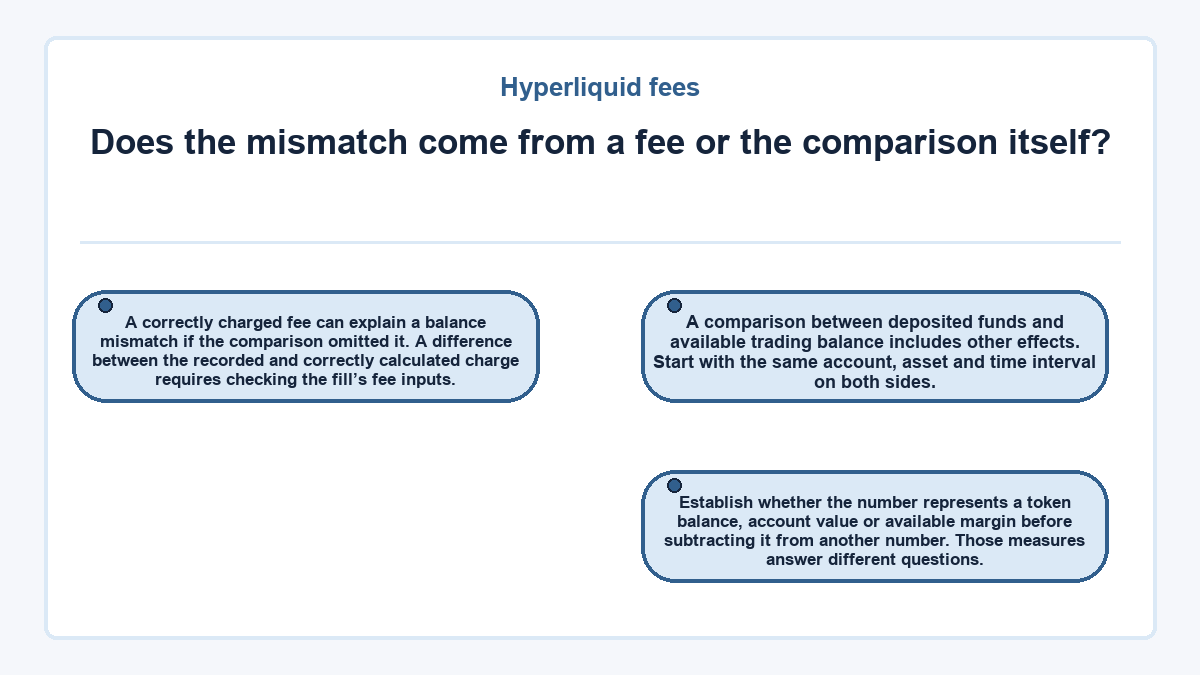
Does the mismatch come from a fee or the comparison itself?
A correctly charged fee can explain a balance mismatch if the comparison omitted it. A difference between the recorded and correctly calculated charge requires checking the fill’s fee inputs. A comparison between deposited funds and available trading balance includes other effects. Start with the same account, asset and time interval on both sides. Establish whether the number represents a token balance, account value or available margin before subtracting it from another number. Those measures answer different questions.
Fill amounts before order totals
Use executed quantity when calculating a charge. Submitted order size includes quantity that might never trade, so it can overstate the fee basis.
For a fill charged in the quote asset, the basic relationship is execution price multiplied by executed size multiplied by the applicable decimal fee rate. When the fee uses another asset, preserve that denomination. Dividing a base-asset charge directly by quote-asset notional produces a meaningless percentage.
The fill data includes price, size, execution time, order identifier, fee amount and fee token. Preserve those fields together. A spreadsheet that drops the fee token can silently combine unlike amounts. Keep original precision through the calculation and round only the displayed result.
Calculate each fill before combining totals. An order can execute across several prices, and its recorded executions need not share one liquidity role. Grouping by order identifier helps explain the order total, but it should not erase the details that determine each charge.
Maker and taker treatment follows execution
An immediately matching limit order takes liquidity, so its price limit does not establish eligibility for maker pricing. A resting order supplies liquidity when another order matches it. The fee comparison must follow that execution role.
A post-only order executes only as a resting order. That restriction prevents immediate taker execution, but it does not promise a fill. Comparing an unfilled maker order with a completed taker trade therefore compares different outcomes. For cost analysis, distinguish the intended execution condition from the role recorded when the trade happened.
The account rate in effect for the fill
A rate displayed now may differ from the rate that applied to an earlier trade. Volume tiers, staking discounts and eligible referral discounts affect the account calculation. Spot and perpetuals have separate schedules despite sharing a volume-based tier. Market-specific adjustments can also affect the final rate.
For historical reconciliation, retain the applicable account and market settings alongside the fill. Do not repeatedly apply a discount that the account rate already includes. A missing historical rate leaves the expected-charge calculation unresolved; it does not establish that the recorded debit was incorrect.
Builder fees without duplicate deductions
An application can attach an authorized builder fee to eligible orders. The user approves a maximum for that builder, while the order specifies the charge. The approval ceiling and the amount actually charged are different values.
The fill’s
fee
field includes its
builderFee
amount when present.
Adding those fields together overstates the deduction. Treat the builder amount as a component of the total. Builder codes apply to both sides of perpetual trades and eligible spot sales, but exclude spot purchases under the documented fee mechanism.
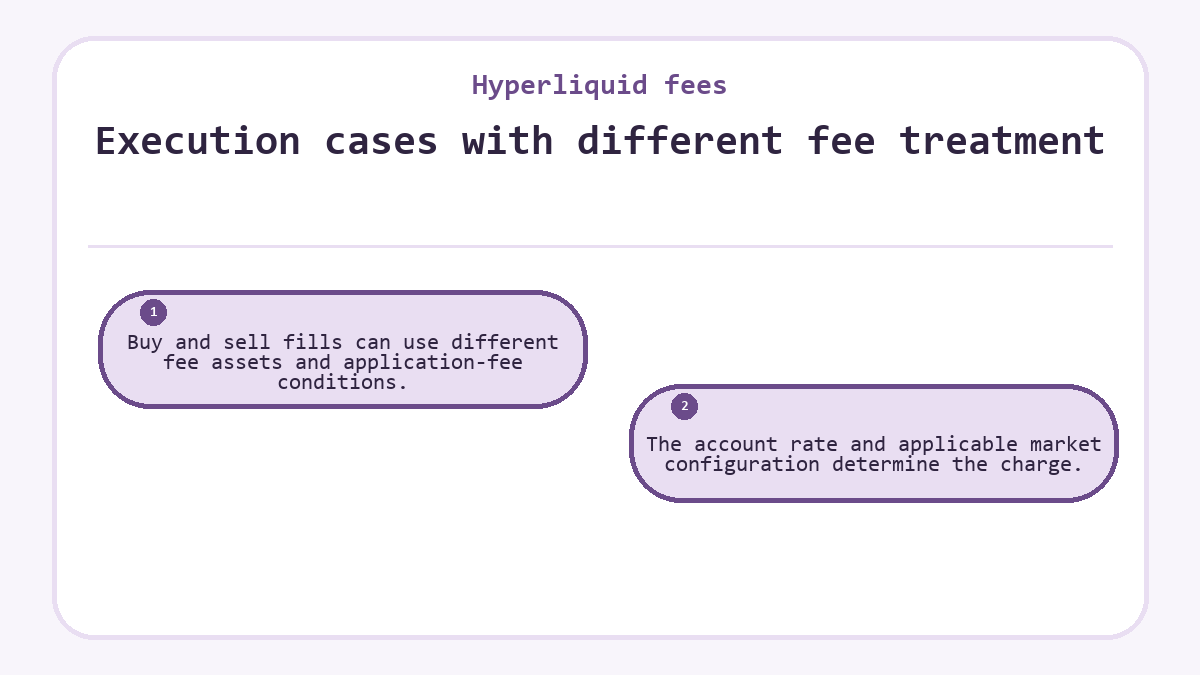
Execution cases with different fee treatment
Buy and sell fills can use different fee assets and application-fee conditions. The account rate and applicable market configuration determine the charge.
| Executed action | Rate basis | Amount to reconcile | Builder-code eligibility |
|---|---|---|---|
| Spot maker purchase | Spot maker rate | Recorded fee in its fee token | Excluded on spot buys |
| Spot taker purchase | Spot taker rate | Recorded fee in its fee token | Excluded on spot buys |
| Spot maker sale | Spot maker rate | Total recorded fee | Eligible with authorization |
| Spot taker sale | Spot taker rate | Total recorded fee | Eligible with authorization |
| Validator-operated perpetual maker fill | Perpetual maker rate | Total recorded fee | Eligible on either side |
| Validator-operated perpetual taker fill | Perpetual taker rate | Total recorded fee | Eligible on either side |
| HIP-3 perpetual fill | Execution role plus market adjustments | Total recorded fee | Eligible on either side |
HIP-3 market deployers can configure an additional fee share. This market setting differs from an application’s builder code, even though both involve a builder. Treating the names as interchangeable can hide a legitimate cost component or cause duplicate accounting.
Why does account value move beyond the trading charge?
Account value can change through funding, profit or loss and transfers as well as trading fees. Portfolio margin can also accrue borrowing costs or interest income on eligible supplied assets. Available margin adds another distinction: collateral committed to supporting positions is not itself a fee payment.
Perpetual funding transfers payments between holders on opposing sides of the contract. Include actual funding entries within the comparison interval. A displayed funding rate describes a calculation input; it is not the amount that the account necessarily paid.
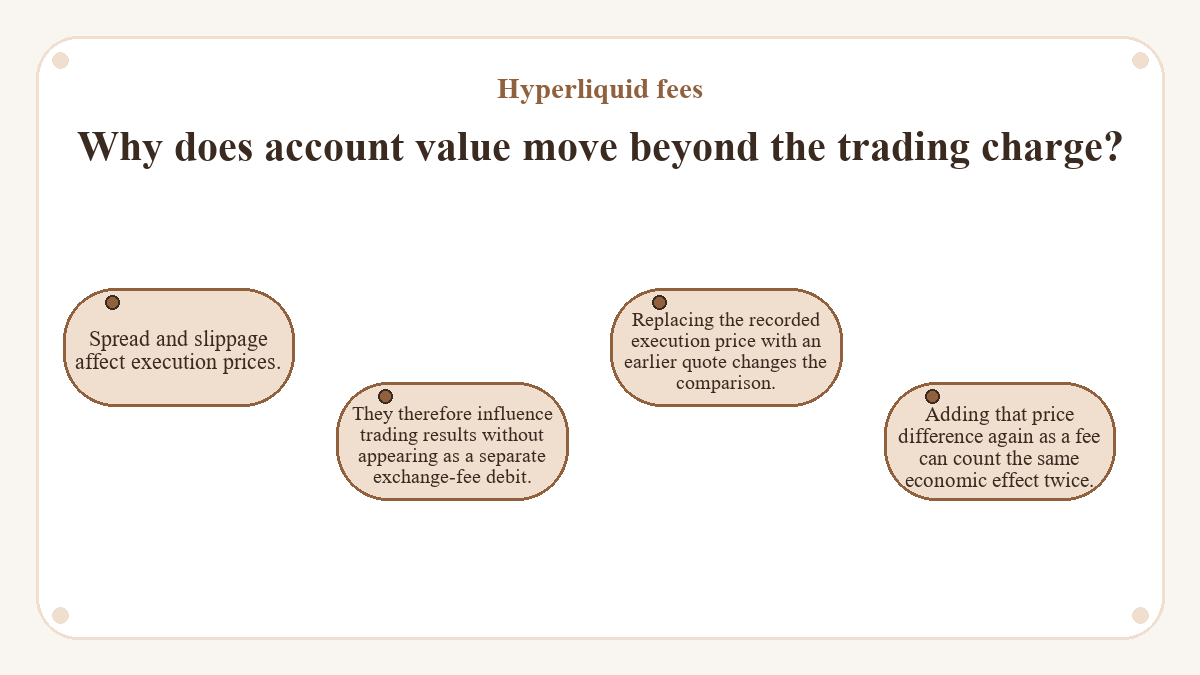
Spread and slippage affect execution prices. They therefore influence trading results without appearing as a separate exchange-fee debit. Replacing the recorded execution price with an earlier quote changes the comparison. Adding that price difference again as a fee can count the same economic effect twice.
Transfers between accounts or balance compartments also need their own treatment. Across a combined account view, an internal transfer may cancel out. Within one compartment, it remains a balance movement. Keep the accounting boundary consistent before deciding that the difference represents unexplained costs.
Reconcile the residual without another trade
A reconciliation should identify the unexplained remainder while preserving the original transactions. Editing an order can lead to new fills that change exposure and incur fees. Executing an offsetting trade also changes exposure and can incur fees; neither action corrects a historical calculation.
Keep comparison work separate from submission. Unsigned inputs can change without executing a trade. Once an order reaches the matching engine, execution can occur before a cancellation takes effect. Completed fills remain part of the cost record, including fills from an order whose remaining quantity was canceled.
For each fee asset, compare the sum of recorded charges with the expected sum for the same executions. Then reconcile the account movement using the relevant trade proceeds, funding, transfers, profit or loss and any portfolio-margin interest paid or earned. If the chosen report already reports a net figure, establish which deductions it includes before subtracting them again.
A complete match explains both the charges and the remaining balance movement. If a difference survives, retain its amount, asset and interval alongside the affected fills. Missing records or historical settings limit the conclusion. They do not justify adjusting the fee total merely to force the balances to agree.
Questions worth asking
Can changing leverage reduce the fee on an unchanged perpetual trade?
Changing leverage alone does not reduce a trading charge calculated on unchanged executed notional. Leverage changes the relationship between exposure and required margin. Comparing the fee with margin instead of trade notional can make the effective percentage appear different even when the execution charge remains unchanged.
Are subaccount and vault volumes combined for fee discounts?
Subaccount volume contributes to the master account’s tier, while vault volume receives separate treatment. Subaccounts share the master account’s fee tier, but referral discounts do not apply to subaccounts. Keep that distinction when explaining why similar trades made through different account arrangements received different charges.
What does a negative maker fee mean in a reconciliation?
A negative maker fee represents a rebate rather than a debit. Preserve its sign when totaling charges; converting every entry to an absolute value turns credits into costs. Eligibility depends on the applicable maker schedule, so a maker fill does not automatically imply a rebate.
Will linking a staking account provide a reversible discount trial?
Staking-account linking is permanent and cannot serve as a reversible discount trial. The staking account gains substantial control over the trading account, including an irreversible funds-transfer capability. Both accounts must belong to the same user; estimating potential savings does not require completing a link.
Why do two exports contain different numbers of fills?
Aggregation settings can combine partial fills, so row counts alone do not establish missing trades. Compare executed quantities and fee totals within matching intervals and asset groups. History responses also have retrieval limits, which means a recent-history response may not cover the entire period that an older export contains.
Does revoking builder approval refund earlier application fees?
Revoking builder approval changes authorization for future charges and does not reverse completed fills. Historical reconciliation must retain the application fees attached to those executions. The approved maximum describes permission; it is not evidence that every eligible order incurred that maximum.
Which arithmetic mistakes can create a small unexplained fee difference?
Premature rounding, mixed asset units and incorrect percentage conversion can create apparent discrepancies. Keep decimal precision until the final display, distinguish a percentage from its decimal multiplier and total each fee asset separately. A difference that remains after those corrections still requires examination of the underlying records.