 Hyperliquid
 matches spot and perpetual orders on its own blockchain
Hyperliquid is a Layer 1 blockchain whose onchain order books match buyers and sellers for spot assets and perpetual futures. Its trading component, HyperCore, processes orders and updates balances or positions after execution. HyperEVM supports general-purpose smart contracts on the same blockchain. Trading involves several distinct states: submitting an instruction, receiving an order response and recording a fill. A successful submission alone does not establish that the requested trade happened.
- last updatedBottom line: An accepted order can remain unfilled; execution records show what traded, while balances and positions show its effect on the account.
Spot purchases and perpetual positions change different account records
A spot trade exchanges assets, while a perpetual trade changes a derivative position backed by collateral. Perpetual futures provide long or short exposure without an expiry date. Holding that exposure involves margin requirements and funding payments. A spot purchase and a perpetual long therefore create different obligations, even when both concern the same underlying asset. HyperCore provides order books for both forms of trading.
The instruction also determines which execution conditions matter. A limit order permits execution at its stated price or better. An immediate-or-cancel instruction cancels any quantity that cannot execute immediately. A good-til-canceled order can leave a remainder on the book. Selecting a limit price controls acceptable execution prices; it does not establish when another order will match.
Does an accepted order mean the trade has finished?
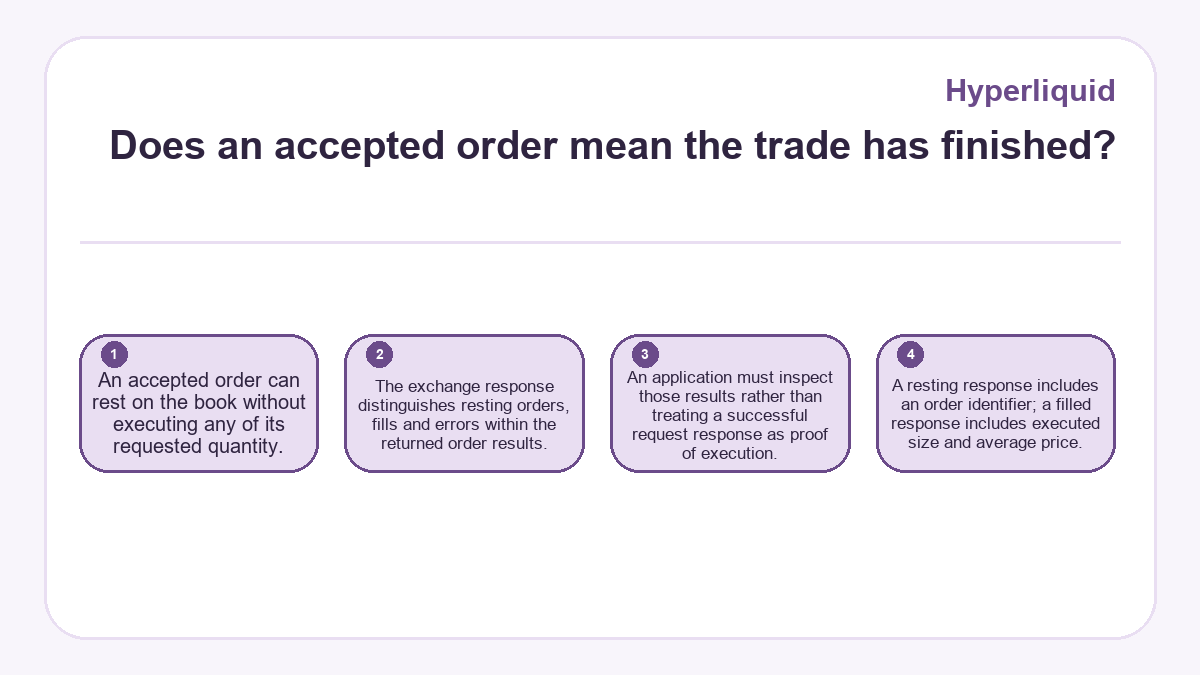
An accepted order can rest on the book without executing any of its requested quantity. The exchange response distinguishes resting orders, fills and errors within the returned order results. An application must inspect those results rather than treating a successful request response as proof of execution. A resting response includes an order identifier; a filled response includes executed size and average price.
Order status and fill history answer different questions. Status describes the order’s condition. Fills record the trades that occurred, including execution price and size. A canceled order can still have earlier fills.
Price priority meets margin checks inside HyperCore
HyperCore matches orders using price-time priority. Better-priced orders receive priority, followed by earlier orders at the same price. Each market also specifies permitted price and size increments. An order must respect these increments before its position in the queue matters. Displayed liquidity describes the book at a particular moment; competing orders and cancellations can change it before another instruction executes.
Perpetual orders also interact with the clearinghouse, which manages positions and margin checks. The protocol checks margin when opening an order and checks the resting side again during matching. A previously accepted order can therefore fail a later margin check. Oracle price changes can alter account conditions while an order waits. Price compatibility alone does not establish that both sides remain eligible to trade.
A limit order moves from submission to a recorded position
Consider an account with sufficient eligible collateral and no position in its selected perpetual market. The holder wants to open a position while retaining control over any unfilled remainder. The account’s margin mode and the market’s permitted order increments establish the prerequisites.
The holder submits a good-til-canceled limit order with a chosen direction, size and price. Compatible liquidity can fill it immediately; otherwise, eligible quantity can rest on the book. The response reports the initial outcome.
| Stage | Protocol action | Observable record | Execution boundary |
|---|---|---|---|
| Submission | Evaluates the signed order | Submitted direction, size and limit price | Acceptance does not guarantee a fill |
| Matching | Executes eligible quantity against compatible orders | Fill price and executed size | Liquidity and margin constrain execution |
| Account update | Records the position resulting from execution | Position size and account state | An unfilled remainder may still be open |
If only part executes, the account holds a position while the remaining order can still trade. Until cancellation takes effect, another fill can increase the position; there is no fixed cancellation deadline for this good-til-canceled order.
A cancellation request addresses the unfilled remainder. It cannot erase an earlier fill.
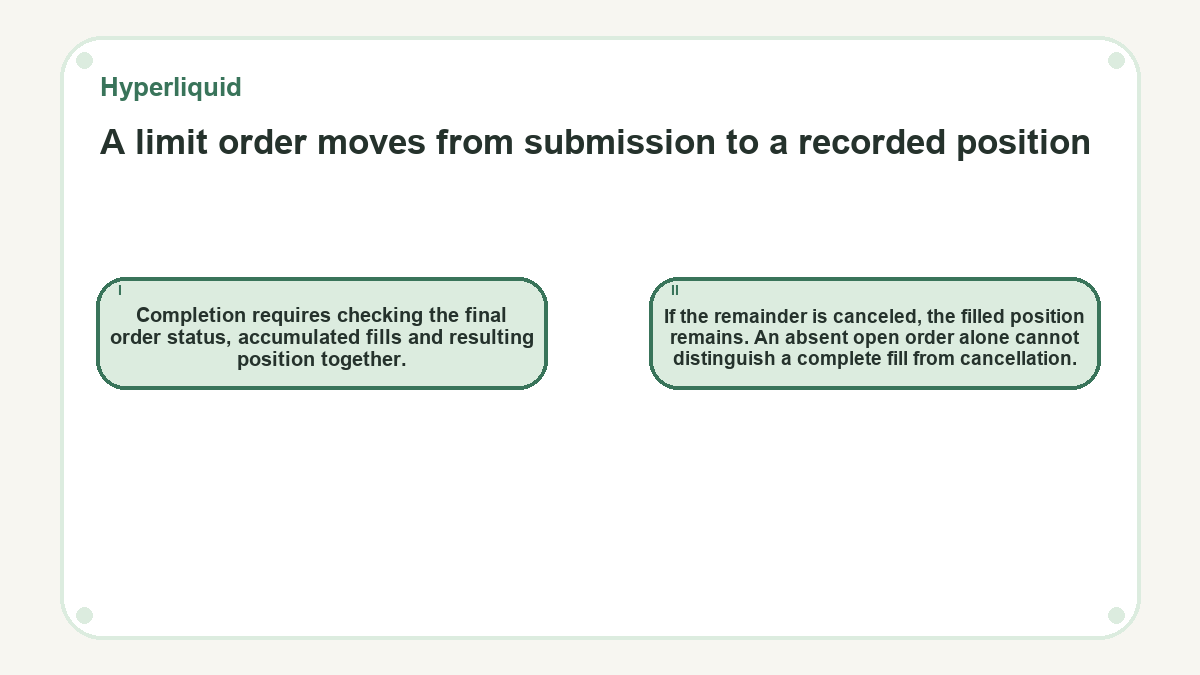
Completion requires checking the final order status, accumulated fills and resulting position together. If the remainder is canceled, the filled position remains. An absent open order alone cannot distinguish a complete fill from cancellation.
Balances reflect more than the execution price
Price times executed size gives the trade’s notional value. The resulting account balance also depends on its starting balance, fees and position accounting. Maker and taker treatment depends on how an order executes. Spot and perpetual trades have separate fee schedules, while account activity and applicable discounts affect the rate. An order’s chosen label alone does not establish every fee that its fills incur.
Perpetual funding payments pass between the long and short sides of a contract. Funding affects the cost of holding a position separately from execution fees. Changes in unrealized profit or loss also affect account equity while a position remains open. Consequently, a later account value need not equal the value immediately after the trade.
Fill records identify executed quantity, price and charged fees. Position records describe the remaining exposure. Match the account and market across these records, then interpret balances according to the account mode. Standard mode separates spot and perpetual balances. Unified account and portfolio margin can use eligible spot balances as perpetual collateral.
Margin mode determines which collateral supports a position
Cross margin shares collateral across eligible positions; isolated margin assigns collateral to an individual position. The sharing boundary depends on account mode and collateral compatibility, especially across multiple perpetual exchanges. Some markets restrict the available margin modes. A position becomes subject to liquidation when its supporting equity falls below maintenance requirements. Completing an opening trade therefore begins an ongoing collateral obligation. Isolating margin limits which collateral supports that position; it does not prevent liquidation.
HyperEVM adds smart contracts alongside the trading engine
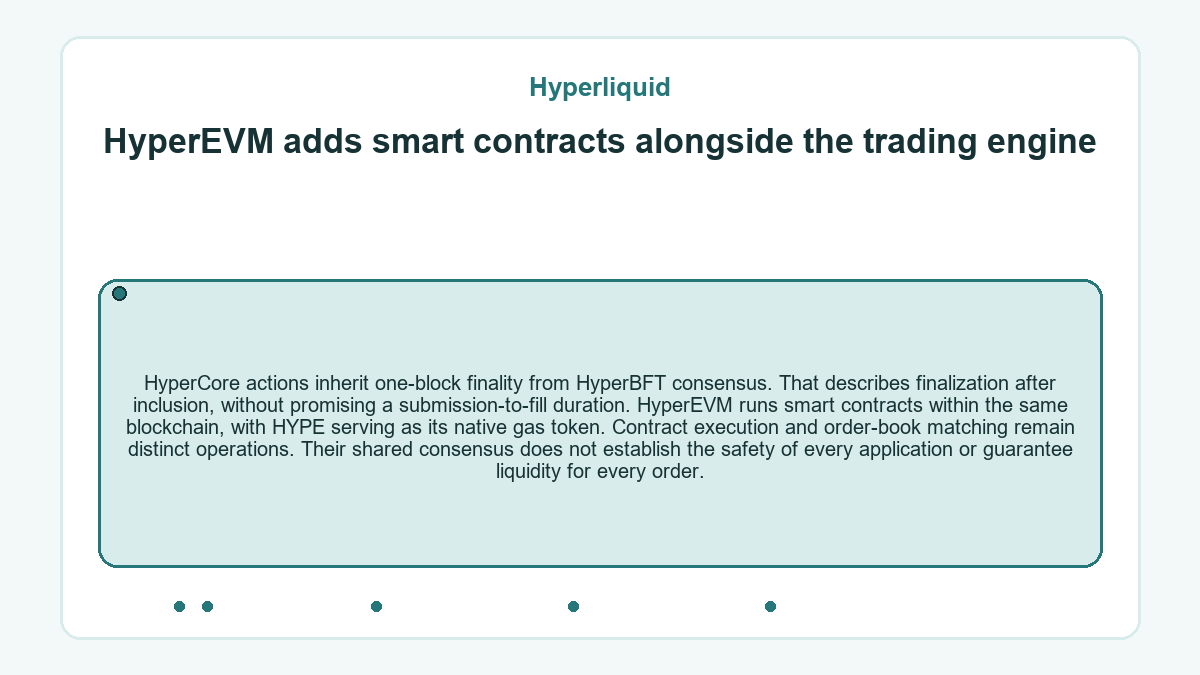
HyperCore actions inherit one-block finality from HyperBFT consensus. That describes finalization after inclusion, without promising a submission-to-fill duration. HyperEVM runs smart contracts within the same blockchain, with HYPE serving as its native gas token. Contract execution and order-book matching remain distinct operations. Their shared consensus does not establish the safety of every application or guarantee liquidity for every order.
Hyperliquid FAQs
-
Why does a post-only order fail when its price would immediately match?
- A post-only order must enter the book as resting liquidity. If it would immediately match another order, the protocol cancels it instead. This behavior preserves the order’s add-liquidity-only condition, even when the entered price would otherwise permit a trade.
-
Can a stop-limit order trigger without closing the position?
- A stop-limit order can trigger without filling because activation creates a limit order. Execution still requires compatible liquidity at the limit price or better. A market that moves beyond that price can leave the order unfilled and the position open.
-
What happens when orders from the same address would trade against each other?
- Self-trade prevention cancels the resting order instead of creating a trade between the same address. That cancellation incurs no trading fee and does not appear as a fill in the trade feed. The incoming order can continue matching other eligible liquidity within its price limit.
-
Which address should an API query use to retrieve trading balances?
- Account queries must use the actual master-account or subaccount address whose data is needed. An approved API wallet signs actions on that account’s behalf. Querying the signing agent’s address instead can return an empty result because the trading records belong to the underlying account.
-
Does a TWAP order always execute its full requested size?
- A time-weighted average price order can finish without executing its full requested size. It divides execution into suborders, which remain subject to liquidity and slippage constraints. Later suborders attempt to catch up after missed execution, but those constraints can prevent completion.
-
Are subaccounts required to have their own private keys?
- Subaccounts do not have private keys. The master account can sign actions for a subaccount, and approved API wallets can also sign on its behalf. The request must identify the intended subaccount so that the action applies to the correct account state.